
Recently, I’ve had the opportunity to sit back and reflect on the type of changes that have occurred over the span of my twenty-three years on earth. The most drastic change that was impossible to overlook was the evolution between how we give and receive information during the early twenty-first century. The establishment of social media and evolution of touch screen phone technology (Apple, Google, Samsung and ect.) has made life more convenient in the way we operate as human beings. However, the ability to access information and interact with others at the palm of your hand has not come without its problems. As technology continues to evolve, the distinction between what is fake and what is real will only become blurrier. The convenience of information has made it more susceptible for people to become targets of propaganda without even realizing it. In this article, we will cover the propaganda’s origins, why it exists today, and developing techniques to spot it.
The History and Evolution of Propaganda:
In order to understand the messages being directed at us we need to define what propaganda is. Bruce Lannes Smith, a professor of political science at Michigan State University states that “Propaganda is the dissemination of information—facts, arguments, rumors, half-truths, or lies—to influence public opinion. Deliberateness and a relatively heavy emphasis on manipulation distinguish propaganda from casual conversation or the free and easy exchange of ideas.”.
The first instances of propaganda are widely expected to be traced back to Ancient Greece. Authors of Propaganda & Persuasion Garth Jowett and Victoria O’Donnell state “The ancient world, prior to 500 b.c.e., provides many examples of effective propaganda techniques being used by rulers, mostly in support of war or religious persuasion.”. After the invention of the printing press, rulers and religions particularly in Europe used mass printing to produce propaganda in favor of their interests. Queen Elizabeth of England and Philip The Second of Spain both used written and printed materials to round up support during a war between the countries in the sixteenth century.
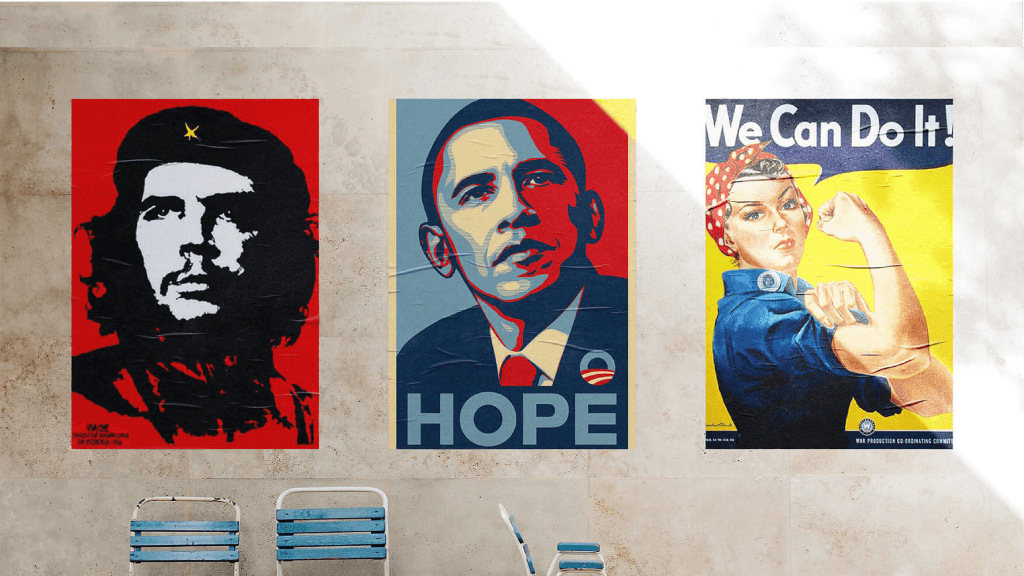
During the middle eighteenth century, Benjamin Franklin published a political cartoon “Join or Die.” in order to rally the colonies to support the British war against the French on American soil. Author Richard Samuel West stated “The first great American political cartoon is also perhaps the best known: Benjamin Franklin’s “Join or Die.”. Another spectacular political cartoonist who used visceral and graphic images for political propaganda was Thomas Nast. He drew gut wrenching images depicting slavery and the South to help influence the public over the wrongdoing of slavery.
Fast forward to World War One and you begin to see whole new forms of information outlets taking place. During this time, patriotic songs were played over nations radio to influence public opinion about the war. Another phenomena that was new to this era were targeted posters with slogans to recruit through various efforts to support the war. One of the most famous pieces of American propaganda was James Montgomery Flagg’s I Want You for U.S. Army (1917) poster. During World War II, you saw propaganda beginning to be shown through another outlet which was being broadcasted in theaters and through radio (voice). Governments began to realize the importance of the messages being sent out around this time and the effects that they have on the emotions of their citizens. Germany is a perfect example of being a propaganda machine which ultimately enabled and led to the atrocities that occurred during that time. In 1941, the first television ad in America was during a baseball game between the Brooklyn Dodgers and the Philadelphia Phillies. Live television and advertisements during the late 1940’s and early 1940’s for news forms of corporate and government propaganda.
Media development and outlet development stayed pretty stagnant up until the early 2000’s with the development on social media and touch screen smartphones. During the 2008 election, you saw for the first time a presidential candidate use social media to reach voters during an election and it was widely successful. David Carr of the New York Times said “the Obama campaign did not invent anything completely new. Instead, by bolting together social networking applications under the banner of a movement, they created an unforeseen force to raise money, organize locally, fight smear campaigns and get out the vote that helped them topple the Clinton machine and then John McCain and the Republicans.”. This campaign introduced politics into social media and allowed it to be another mouthpiece for corporate and government propaganda.

Modern Day Propaganda (Where is it?)
Now that we have an understanding of propaganda we can begin to lift the mask as to what it is currently today. The short answer is that it hides in plain sight and the long answer is that it is everywhere. We as humans are exposed to so many subliminal messages that it becomes at times completely undetectable. You either aren’t interested in the message, have views that align with the message, or it provokes a response on some scale. In this modern age, there are just too many outlets pushing too many messages to get your attention all the time and thus becoming subliminal.
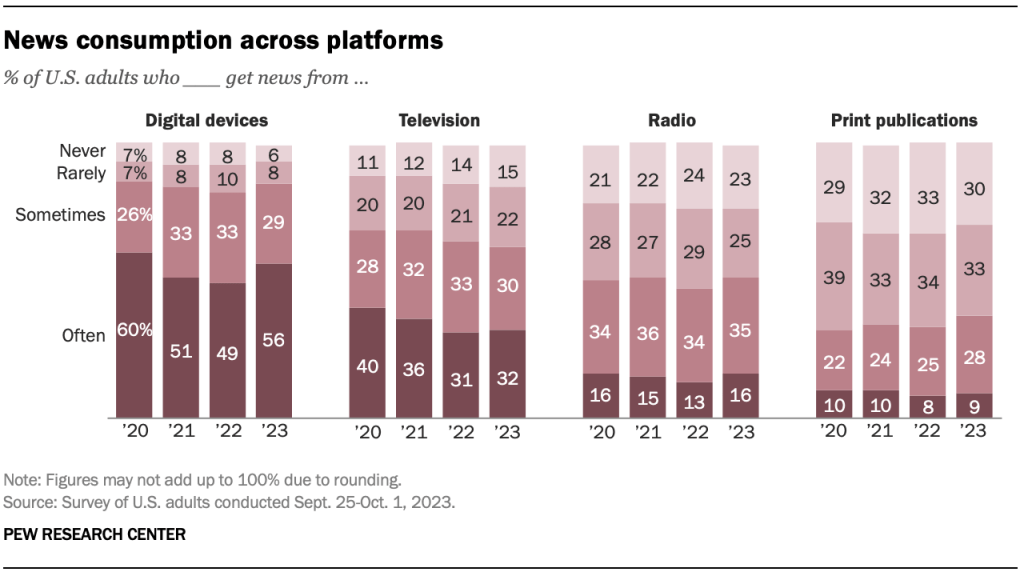
Where does the propaganda come from? Well let’s first take a look at the outlets projecting these messages. Pew Research Center conducted a study on news consumption across platforms and found “nearly six-in-ten Americans say they prefer a digital device (58%), more than say they prefer TV (27%). Even fewer Americans prefer radio (6%) or print (5%).”. At least in America it’s safe to say digital devices are the kings of outlets.
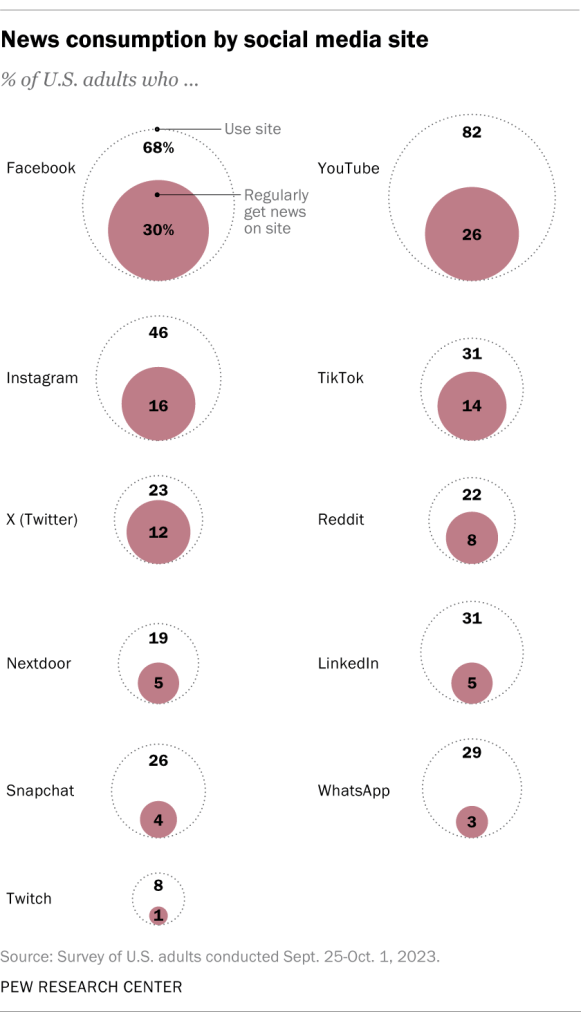
What platforms are being used to push these messages? The majority of content that is being pushed through these outlets is primarily on social media platforms. This is where large corporations, governments, news outlets, non-profit organizations, small businesses, groups, and individuals all can share their own messages. Meta by far is the largest corporation that owns the majority of large social media platforms. Instagram and Facebook (Meta) are their largest platforms that generate the most of their revenue through advertisements. Other companies such as Google, X, Snapchat, Twitch, and Youtube (owned by google) are designed to promote messages from advertisers and keep you engaged in order to make the most possible amount of money. Although there are guidelines to what can be posted and advertised they are rarely ever followed up on these platforms. All of these onlines entities are battling for your attention and trying to influence your opinion for one reason or another. Advertising messages and different types of propaganda are shown in other areas such as cable news, streaming services, and traditional advertising avenues.
How does it reach you? Not all content is bought and paid for online. The majority of it is actually organic content. However, there are different ways to see content and propaganda. Algorithms are the number one determining factor for what you see in your feed and searches in pretty much any device you’re using. An article from the University of York stated “An algorithm is a coded formula written into software that, when triggered, prompts the tech to take relevant action to solve a problem. Computer algorithms work via input and output. When data is entered, the system analyzes the information given and executes the correct commands to produce the desired result.”. Bots and artificial intelligence are working its way into the mainstream in order to try and affect what you see currently as well. However, what you search, watch, click, and or interact with online determines the messages that are being brought to you.
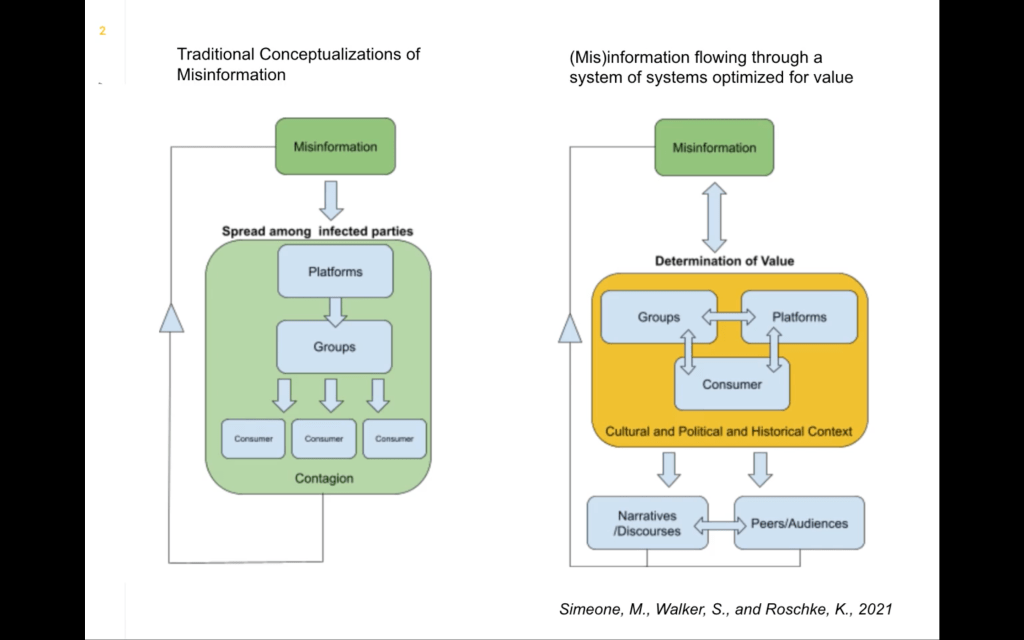
Why would we believe the lies and how does it affect you? We believe what we see for one simple reason and that is because we are biased. “Many of the decisions we make as individuals and as a society depend on accurate information; however, our psychological biases and predispositions make us vulnerable to falsehoods.” says Richard Sima of The Washington Post. We tend to believe accounts that make information that tailors to our bias. The majority of the time we don’t even check the facts before we repost or spread the information ourselves. If a propaganda message is effective, the chances for it to spread like wildfire are higher than ever. Echo chambers often form out of algorithmic models that are essentially industry standard.

Today’s Propaganda and How to Spot it:
Lucky enough for us we have tools to help us identity propaganda that could potentially be harmful to us. The University of Vermont’s Propaganda Techniques To Recognize is the more comprehensive list of terms to help you identify how propaganda is presented and spread. Please review the terms in the link provided! The final tool I would like to recommend would be Simon Fraser University’s How to spot fake news: Identifying propaganda, satire, and false information. The chart they provide lists six comprehensive steps that really help identify fake or harmful articles. It is important to remember that propaganda is everywhere and it is very easy to be influenced if you aren’t aware of it. This article should give you the information, background, and tools to help you become more aware in your decision making the next time you are presented with any information!

 NIck Layman's Blog
Leave a comment